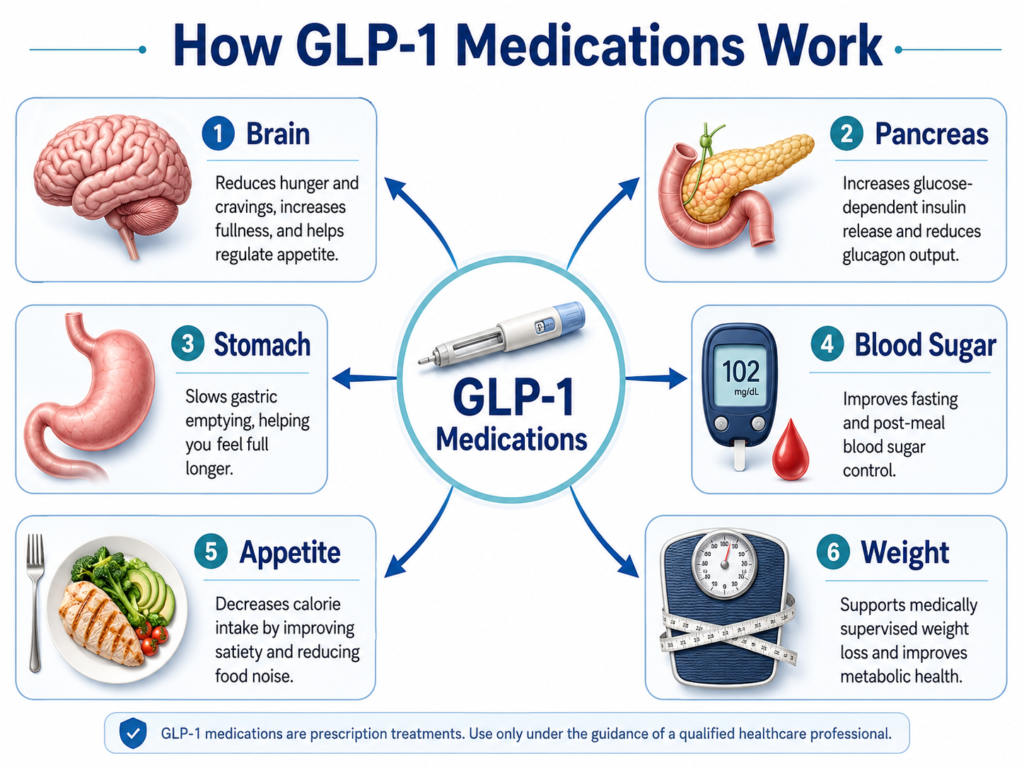
GLP-1 medications have transformed the treatment of obesity and type 2 diabetes. Medications containing semaglutide or tirzepatide are often described as appetite suppressants, but that explanation is incomplete. Understanding how GLP-1 medications work can help patients set realistic expectations. They do not simply “melt fat,” dramatically accelerate metabolism, or replace the need for nutrition, physical activity, sleep, and appropriate medical monitoring.
These medications interact with hormone-signaling pathways that connect the gastrointestinal system, pancreas, brain, and other metabolically active tissues. Their effects can influence hunger, fullness, food intake, blood-glucose regulation, insulin secretion, glucagon release, and gastric emptying.
Interested in medical weight management
Complete a secure online evaluation at your convenience to get a head start on treatment or schedule an in-person consultation at our Eldersburg office.
GLP-1 stands for glucagon-like peptide-1. It is a naturally occurring incretin hormone released primarily from specialized intestinal cells after food enters the digestive tract.
An incretin is a hormone that helps the body prepare for and manage the rise in blood glucose that follows a meal. Native GLP-1 communicates with several organs, including the pancreas, brain, stomach, and gastrointestinal tract.
Natural GLP-1 does not remain active for very long because it is rapidly broken down by an enzyme called dipeptidyl peptidase-4, or DPP-4. Medications such as semaglutide have been structurally modified to resist this rapid breakdown and remain active much longer. Semaglutide also binds extensively to albumin, which helps prolong its activity and supports once-weekly administration in its injectable form.
A receptor agonist is a substance that binds to a receptor and activates it.
Semaglutide is a GLP-1 receptor agonist. It has approximately 94% sequence similarity to natural human GLP-1 and selectively activates the GLP-1 receptor.
Tirzepatide is slightly different. Although it is frequently included in conversations about “GLP-1 medications,” it is technically a dual GIP and GLP-1 receptor agonist. That means it activates:
Both receptor systems are involved in metabolic regulation. The addition of GIP activity may contribute to tirzepatide’s effects on appetite, food intake, glucose regulation, and body weight.
One of the most important actions of GLP-1 medications occurs in the pancreas.
When blood glucose rises, GLP-1 receptor activation helps pancreatic beta cells release insulin. Insulin allows glucose to move from the bloodstream into cells, where it can be used or stored.
This insulin response is glucose-dependent. In practical terms, the medication’s effect on insulin secretion becomes more active when glucose is elevated and less active when glucose is lower. That is one reason GLP-1 medications used alone generally have a lower risk of causing significant hypoglycemia than medications that stimulate insulin regardless of glucose level.
The risk of low blood sugar can increase when a GLP-1 medication is combined with insulin or an insulin-stimulating medication such as a sulfonylurea. Those patients may require closer glucose monitoring and medication adjustment.
Glucagon is another pancreatic hormone. While insulin generally lowers blood glucose, glucagon tells the liver to release stored glucose into the bloodstream.
After a meal, excessive glucagon activity can contribute to elevated blood glucose, particularly in people with type 2 diabetes. GLP-1 receptor agonists help reduce glucagon secretion when glucose is elevated.
The combined effect of increased glucose-dependent insulin secretion and reduced glucagon signaling can improve both fasting and post-meal glucose levels. The Ozempic prescribing information describes these pancreatic actions as central components of semaglutide’s glucose-lowering mechanism.
GLP-1 receptors are present in brain regions involved in appetite regulation and food intake. Activating these receptors can strengthen fullness signals and reduce hunger, cravings, and the drive to continue eating.
Patients sometimes describe this experience as:
The phrase “food noise” is often used to describe persistent thoughts about eating, cravings, or planning the next meal. Although it is not a formal medical diagnosis, many patients report that these thoughts become less intrusive during treatment.
In a randomized trial of adults with obesity, once-weekly semaglutide reduced hunger, food cravings, and calorie intake while improving participants’ perceived control over eating.
This central appetite effect is believed to be one of the most important reasons semaglutide and tirzepatide support weight reduction. Current product labeling states that decreased calorie intake is likely mediated primarily through appetite regulation.
Gastric emptying refers to the movement of food from the stomach into the small intestine.
GLP-1 receptor activation can slow gastric emptying, especially early in treatment. This may reduce how quickly nutrients enter the circulation and may contribute to earlier fullness and lower post-meal glucose elevations.
However, delayed gastric emptying is not the entire explanation for weight loss.
The effect may vary according to:
With tirzepatide, the delay in gastric emptying is greatest after the first dose and diminishes over time.
In longer-duration semaglutide trials, participants continued to experience lower appetite and reduced calorie intake even when testing did not demonstrate a significant difference in gastric emptying at week 20. This suggests that direct appetite regulation in the brain may remain important even as the stomach-emptying effect changes over time.
GLP-1 medications do not directly eliminate calories that have already been eaten. Instead, they make it easier for many patients to consistently consume fewer calories by decreasing hunger and increasing fullness.
This distinction matters. The medication creates a biological environment in which eating less may feel more manageable, but the quality of that reduced food intake remains important.
A patient eating fewer calories can still become deficient in:
Inadequate protein intake and the absence of resistance training can also increase the amount of lean mass lost during weight reduction. Therefore, effective medical weight management should monitor more than the number on the scale.
By coordinating insulin secretion, glucagon suppression, appetite regulation, and nutrient delivery from the stomach, GLP-1 medications can reduce both fasting and postprandial glucose.
This is particularly important for people with type 2 diabetes, insulin resistance, metabolic syndrome, or obesity-related glucose dysregulation.
Tirzepatide also has evidence of improving insulin sensitivity. Its prescribing information reports increased insulin sensitivity in a metabolic clamp study involving adults with type 2 diabetes.
These metabolic improvements may occur alongside weight reduction, although some glucose-lowering effects begin before a person has lost a substantial amount of weight.
Improved glucose regulation and reduced calorie intake can decrease the amount of excess energy directed toward fat storage.
Over time, treatment may be associated with:
However, these outcomes should not be described as the medication directly “burning fat.” Much of the change occurs because of reduced energy intake, weight loss, improved insulin regulation, and broader metabolic changes.
GLP-1 medications are sometimes marketed as metabolism boosters. That description is misleading.
Their best-established weight-management effect is a reduction in calorie intake driven by changes in appetite, hunger, fullness, and eating behavior. They may also improve glucose handling and insulin sensitivity, but patients should not expect the medication to compensate for chronically inadequate sleep, sedentary behavior, low protein intake, or loss of muscle mass.
Preserving muscle is especially important because skeletal muscle supports strength, glucose disposal, mobility, physical performance, and long-term energy expenditure.
A well-designed program should therefore combine medication, when appropriate, with:
The same pathways that improve fullness and affect gastric emptying can also create gastrointestinal symptoms.
Common side effects include:
Symptoms are often more noticeable when treatment begins or after the dose is increased. Eating large portions, eating rapidly, consuming high-fat meals, becoming dehydrated, or escalating the dose too quickly may worsen symptoms.
This is why dose escalation should be individualized. The objective is not simply to reach the highest dose. The appropriate dose is the one that provides meaningful clinical benefit while remaining reasonably well tolerated.
No.
Semaglutide activates the GLP-1 receptor. Tirzepatide activates both the GIP and GLP-1 receptors.
Are GLP-1 medications appropriate for everyone?
No medication is appropriate for every patient.
Before prescribing a GLP-1 or dual GIP/GLP-1 medication, a clinician should review factors such as:
Semaglutide and tirzepatide products carry boxed warnings regarding thyroid C-cell tumors observed in rodents. They are contraindicated in patients with a personal or family history of medullary thyroid carcinoma or MEN 2. Their human relevance remains uncertain, but the contraindication must still be respected.
GLP-1 medications work through several coordinated pathways.
They can:
They are not simply appetite suppressants, and they are not substitutes for a comprehensive medical weight-management plan.
The most effective approach combines appropriate patient selection, individualized dosing, nutritional support, adequate protein, resistance training, side-effect management, and ongoing medical monitoring.
At Vybrant Health and Wellness in Eldersburg, Maryland, medical weight-management care begins with an individualized evaluation rather than a one-size-fits-all prescription. Your health history, laboratory results, body composition, previous weight-loss efforts, current medications, nutritional intake, and long-term goals should all be considered before selecting a treatment plan.
Eligible patients in Maryland and Delaware may receive in-person or telehealth care based on their location and clinical needs
Some patients notice changes in appetite during the first few doses, while others require gradual dose escalation before experiencing a meaningful effect. Weight and metabolic changes generally develop over several weeks to months.
Certain GLP-1 or dual-receptor medications are FDA-approved for chronic weight management in eligible patients who do not have diabetes. Eligibility depends on the specific product, body-mass index, medical history, and weight-related health conditions.
The risk is generally lower when they are used alone because their insulin-stimulating effects are glucose-dependent. The risk increases when they are combined with insulin or medications such as sulfonylureas.
No. They influence appetite signaling and may temporarily alter gastric emptying, but they do not surgically reduce the size of the stomach.
No. Research suggests that appetite regulation, reduced food cravings, improved control over eating, and lower calorie intake are major contributors. The gastric-emptying effect may lessen over time with some long-acting medications.
Coadministration of tirzepatide with another GLP-1 receptor agonist is not recommended. Combining these medications could increase adverse effects without established clinical benefit.
Approved weight-management products are indicated in combination with reduced-calorie nutrition and increased physical activity. Medication can improve the biological signals involved in hunger, but long-term health outcomes still depend on nutrition, movement, muscle preservation, sleep, and medical follow-up
No. Dose selection should be based on treatment response, tolerability, clinical goals, and the specific medication’s prescribing instructions. Higher is not automatically better.
Prescription weight-loss medications, including GLP-1 receptor agonists and dual GIP/GLP-1 receptor agonists, are not appropriate for everyone. Treatment eligibility is determined only after a comprehensive medical evaluation and review of your medical history, current medications, laboratory data (when indicated), and individual health goals.
Results vary from person to person. No amount of weight loss or specific clinical outcome can be guaranteed. Medication is intended to be used as part of a comprehensive treatment plan that includes nutrition, physical activity, and lifestyle modification when appropriate.
Telehealth services are available only to patients who are physically located in states where Vybrant Health and Wellness is licensed to practice at the time care is provided. Completing an online medical evaluation or questionnaire does not guarantee treatment, a prescription, or acceptance as a patient. All treatment recommendations are made solely at the discretion of the evaluating healthcare provider based on medical appropriateness and applicable laws and regulations.