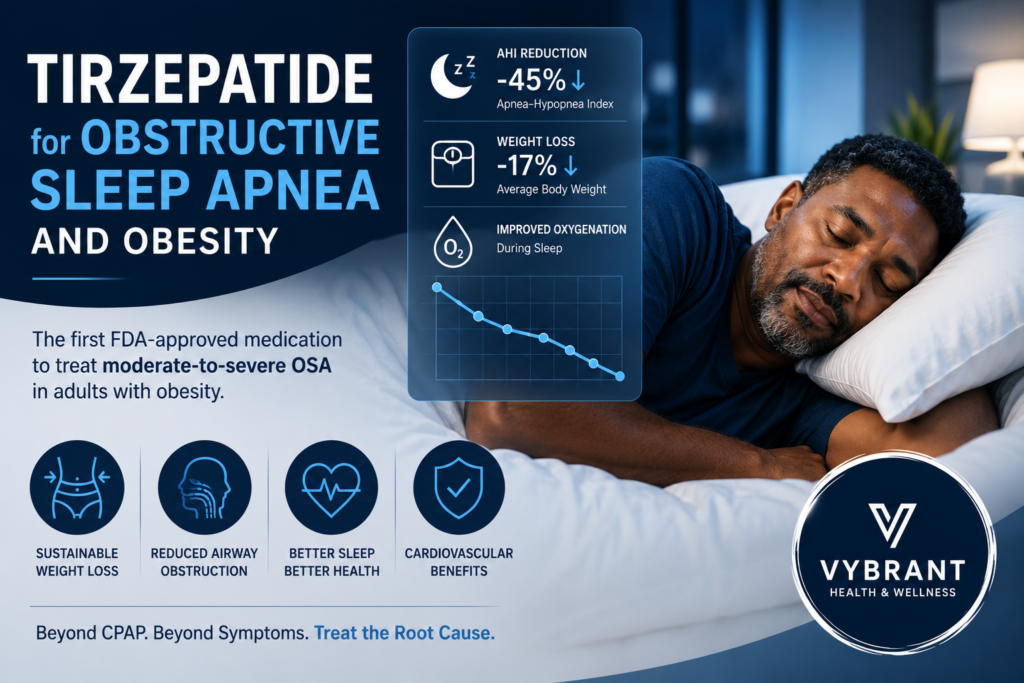
Obstructive sleep apnea (OSA) affects millions of adults and is far more than loud snoring. It is a chronic medical condition characterized by repeated episodes of upper airway collapse during sleep, resulting in intermittent oxygen deprivation, fragmented sleep, excessive daytime fatigue, impaired cognitive function, and increased cardiovascular risk (Malhotra et al., 2024). For decades, treatment options primarily included continuous positive airway pressure (CPAP), oral appliances, weight loss, and surgery. While CPAP remains highly effective, many individuals struggle with long-term adherence due to discomfort or intolerance. Now there is tirzepatide for obstructive sleep apnea
A major advancement occurred in December 2024 when the U.S. Food and Drug Administration (FDA) approved tirzepatide as the first medication indicated for moderate-to-severe obstructive sleep apnea in adults with obesity, when used alongside a reduced-calorie diet and increased physical activity. This approval was based on the landmark SURMOUNT-OSA clinical trials, which demonstrated clinically meaningful improvements in sleep apnea severity and body weight
Interested in Weight Loss and Sleep Apnea Treatment?
If you have obesity and obstructive sleep apnea, our comprehensive metabolic health program evaluates whether lifestyle interventions, weight management strategies, or medications such as tirzepatide may be appropriate for your individual health goals.
Complete a secure online evaluation at your convenience to get a head start on treatment or schedule an in-person consultation at our Eldersburg office.
Obstructive sleep apnea occurs when the muscles of the upper airway relax repeatedly during sleep, causing partial or complete blockage of airflow.
Each episode may last several seconds and occur dozens—or even hundreds—of times each night. These interruptions reduce oxygen levels, activate the sympathetic nervous system, and repeatedly disrupt normal sleep architecture.
Common symptoms include:
Untreated OSA has been associated with increased risks of hypertension, atrial fibrillation, stroke, heart failure, coronary artery disease, insulin resistance, type 2 diabetes, and premature mortality (Malhotra et al., 2024).
Obesity is one of the strongest risk factors for obstructive sleep apnea.
Excess fat accumulation around the neck, tongue, and upper airway narrows the airway and increases its tendency to collapse during sleep. In addition, abdominal obesity reduces lung volume, further increasing airway instability.
Weight loss is therefore considered one of the most effective non-surgical treatments for obesity-related OSA.
However, achieving and maintaining significant weight loss through lifestyle changes alone can be challenging, which has increased interest in medications that target obesity while improving sleep apnea severity.
Tirzepatide is a once-weekly injectable medication that activates both:
This dual mechanism helps regulate appetite, improve satiety, slow gastric emptying, enhance insulin sensitivity, and promote significant weight loss.
Originally approved for type 2 diabetes and later for chronic weight management, tirzepatide is now also FDA-approved for adults with obesity and moderate-to-severe obstructive sleep apnea.
Although tirzepatide does not mechanically hold the airway open like CPAP, it addresses one of the primary drivers of obesity-related OSA which is excess body weight.
Weight reduction can lead to:
These physiologic improvements may substantially reduce the number of breathing interruptions experienced during sleep.
The FDA approval was based on two international Phase 3 SURMOUNT-OSA randomized, double-blind, placebo-controlled clinical trials involving adults with obesity and moderate-to-severe obstructive sleep apnea.
The studies included individuals who:
After 52 weeks of treatment, participants receiving tirzepatide experienced:
Many participants also achieved remission or mild OSA compared with placebo (Malhotra et al., 2024).
Not necessarily.
Continuous positive airway pressure remains the gold standard treatment for many patients with moderate-to-severe OSA because it immediately prevents airway collapse during sleep.
For patients who tolerate CPAP well, tirzepatide may serve as an additional therapy rather than a replacement.
Some individuals who experience substantial weight loss may require lower CPAP pressures or demonstrate marked improvements in OSA severity, but treatment decisions should always be guided by repeat sleep testing and consultation with a sleep medicine specialist (Malhotra et al., 2024).
Patients should never discontinue CPAP therapy without medical guidance.
Beyond improving sleep apnea severity, tirzepatide has demonstrated benefits that may improve overall cardiometabolic health.
Clinical studies have shown improvements in:
Because obesity contributes to numerous chronic diseases, these improvements may reduce long-term health risks extending beyond sleep apnea alone (Jastreboff et al., 2022; Malhotra et al., 2024).
Tirzepatide may be appropriate for adults who have:
Treatment decisions should always follow a comprehensive medical evaluation that considers medical history, current medications, laboratory findings, and sleep study results.
At Vybrant Health & Wellness, we recognize that sleep apnea is often part of a broader metabolic health picture.
Our comprehensive evaluations consider:
When appropriate, we develop individualized treatment plans that integrate lifestyle medicine with evidence-based therapies to improve long-term health outcomes.
Whether you are newly diagnosed with obstructive sleep apnea or have struggled with obesity-related sleep issues for years, we can help determine whether tirzepatide or another evidence-based treatment may be appropriate.
At Vybrant Health and Wellness in Eldersburg, Maryland, medical weight-management care begins with an individualized evaluation rather than a one-size-fits-all prescription. Your health history, laboratory results, body composition, previous weight-loss efforts, current medications, nutritional intake, and long-term goals should all be considered before selecting a treatment plan.
Eligible patients in Maryland and Delaware may receive in-person or telehealth care based on their location and clinical needs
Complete a secure online medical evaluation from home. Eligible patients may begin treatment remotely after provider review.
Prefer a face-to-face consultation? Schedule a comprehensive metabolic health evaluation at our Eldersburg office.
Yes. In December 2024, the FDA approved tirzepatide (Zepbound®) as the first medication for adults with obesity and moderate-to-severe obstructive sleep apnea when used alongside diet and exercise
No. While many patients experience substantial improvements—and some achieve remission or mild disease—OSA is a chronic condition that requires ongoing evaluation and management.
Not without guidance from your healthcare provider. CPAP should only be discontinued after repeat sleep testing confirms it is no longer necessary.
Participants in the SURMOUNT-OSA trials experienced average weight reductions of approximately 16–17% over 52 weeks, along with significant reductions in sleep apnea severity.
No. The FDA approval specifically applies to adults with moderate-to-severe obstructive sleep apnea and obesity. Individual eligibility should be determined by a qualified healthcare provider.
Approved weight-management products are indicated in combination with reduced-calorie nutrition and increased physical activity. Medication can improve the biological signals involved in hunger, but long-term health outcomes still depend on nutrition, movement, muscle preservation, sleep, and medical follow-up
No. Dose selection should be based on treatment response, tolerability, clinical goals, and the specific medication’s prescribing instructions. Higher is not automatically better.
Prescription weight-loss medications, including GLP-1 receptor agonists and dual GIP/GLP-1 receptor agonists, are not appropriate for everyone. Treatment eligibility is determined only after a comprehensive medical evaluation and review of your medical history, current medications, laboratory data (when indicated), and individual health goals.
Results vary from person to person. No amount of weight loss or specific clinical outcome can be guaranteed. Medication is intended to be used as part of a comprehensive treatment plan that includes nutrition, physical activity, and lifestyle modification when appropriate.
Telehealth services are available only to patients who are physically located in states where Vybrant Health and Wellness is licensed to practice at the time care is provided. Completing an online medical evaluation or questionnaire does not guarantee treatment, a prescription, or acceptance as a patient. All treatment recommendations are made solely at the discretion of the evaluating healthcare provider based on medical appropriateness and applicable laws and regulations.
Jastreboff, A. M., Aronne, L. J., Ahmad, N. N., et al. (2022). Tirzepatide once weekly for the treatment of obesity. New England Journal of Medicine, 387(3), 205–216. https://doi.org/10.1056/NEJMoa2206038
Malhotra, A., Grunstein, R. R., Fietze, I., Weaver, T. E., Redline, S., Azarbarzin, A., Sands, S. A., Schwab, R. J., Dunn, J. P., Chakladar, S., Bunck, M. C., Bednarik, J., & the SURMOUNT-OSA Investigators. (2024). Tirzepatide for the treatment of obstructive sleep apnea and obesity. New England Journal of Medicine, 391(13), 1193–1205. https://doi.org/10.1056/NEJMoa2404881
U.S. Food and Drug Administration. (2024, December 20). FDA approves first medication for obstructive sleep apnea. https://www.fda.gov/news-events/press-announcements/fda-approves-first-medication-obstructive-sleep-apnea