

Animal studies
Blood sugar control
In mice, MOTS-c helped the body use insulin better, including in older mice. In people, lower MOTS-c levels have been linked with type 2 diabetes, but it hasn't been tested as a treatment.
Explore related research
UNDERSTANDING THE PEPTIDE
Most of your body's proteins are built from instructions in the center of your cells. MOTS-c is different: its instructions come from your mitochondria, the tiny parts of your cells that turn food into energy. Scientists at the University of Southern California discovered it in 2015.
1 · WHERE IT COMES FROM
Its instructions are stored in your mitochondria’s own DNA.
2 · WHAT IT IS
A short chain of 16 building blocks (amino acids), small enough to travel in your blood to tissues like muscle.
3 · WHAT IT DOES
In lab studies, it turns on the cell’s energy sensor, which helps cells take in and burn fuel.
MOTS-c is not FDA-approved for any use. Most of what we know comes from cell and animal research. In people, the clearest finding is that your body makes more of its own MOTS-c when you exercise, and regular movement is still the best-proven way to raise it.
Explore the scienceWHAT MOTS-C IS BEING STUDIED FOR
Each card says how strong the evidence is. No published clinical trial has tested MOTS-c injections for health results in people yet, so none of these benefits is proven.
In mice, MOTS-c helped the body use insulin better, including in older mice. In people, lower MOTS-c levels have been linked with type 2 diabetes, but it hasn't been tested as a treatment.
Explore related researchMOTS-c prevented diet-induced weight gain in mice on a high-fat diet. It isn't a weight-loss medication, and human results aren't available.
Explore related researchExercise raises your own MOTS-c, and mice given MOTS-c ran longer. Better performance from injections hasn't been shown in people.
Explore related researchTreatment late in life improved physical function in older mice. There's no evidence that MOTS-c extends lifespan or slows aging in people.
Explore related researchLab studies suggest MOTS-c helps cells handle stress and turn on protective genes. It isn't a treatment for inflammatory or autoimmune disease.
Explore related researchAnimal studies and blood-level comparisons hint at a role in heart metabolism. These are early findings, not proof of heart protection.
Explore related researchYOUR OPTION
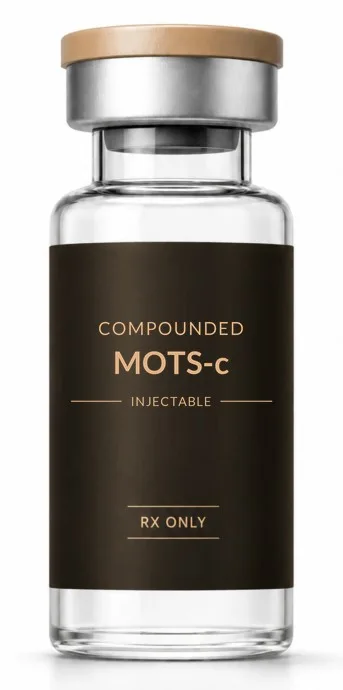
PEPTIDE · INJECTION
A lab-made version of the mitochondrial peptide, given by small injection under the skin. If it's prescribed, your clinician explains exactly how to use it.
Starting at $429/month, or $999 for a 3-month supply
Clinician follow-up included. No membership fees or hidden costs.
CARE DESIGNED AROUND THE INDIVIDUAL
Five steps, all from home. We don't promise results by a certain week.
ASSESSMENT
Share your goals, symptoms, medications and health history online.
MEDICAL REVIEW
A licensed clinician checks for risks and reasons not to treat.
INDIVIDUALIZED PLAN
Labs, lifestyle changes, other options or MOTS-c, whatever fits you best.
TREATMENT DECISION
If prescribed, you get personal instructions and safety guidance from our team.
ONGOING CARE
Check-ins on how you feel, side effects and blood sugar where appropriate.
No. It isn't approved for any use. Since October 2026, federal policy lets licensed pharmacies compound it under strict conditions, but that's not FDA approval.
We don't fully know. There's no long-term human safety data for MOTS-c injections, and the FDA has said it found no human exposure data for compounded MOTS-c. Your clinician will go over what's known and what isn't.
It might, but that hasn't been shown in people. The energy-related findings come from cell and mouse studies.
It reduced diet-induced weight gain in mice, but it isn't a weight-loss medication and human results aren't available. If weight is your main goal, GLP-1 medications have far stronger evidence.
Yes. In a small study of healthy men, blood MOTS-c rose several-fold during exercise. MOTS-c doesn't replace exercise, which is still the best-proven way to support your metabolism.
Not if you're subject to drug testing. MOTS-c is on the World Anti-Doping Agency (WADA) prohibited list at all times, in and out of competition.
It improved physical function in older mice, but there's no evidence it slows aging or extends lifespan in people.
Those products aren't made for people. Their purity, dose and sterility aren't checked, and nobody is reviewing your health before you use them.
Human data are limited. Reported effects of peptide injections include redness or bumps at the injection site, flushing, headache, nausea and dizziness. Because MOTS-c may affect blood sugar, tell us about any diabetes medicines.
MOTS-c starts at $429 a month, or $999 for a 3-month supply. Your clinician follow-up is included, with no membership fees or hidden costs. We'll go over your exact price before you're charged.
Yes, you start with an online assessment. Your clinician may ask for labs or a video visit depending on what they find.
IMPORTANT SAFETY INFORMATION
Your clinician reviews all of this with you before anything is prescribed.
Human data are limited. Reported effects of peptide injections include injection-site reactions, flushing, headache, nausea and dizziness. Tell us right away about any reaction that worries you.
MOTS-c is not FDA-approved. Since October 2026, an HHS policy lets 503A compounding pharmacies prepare it only when ten conditions are met, including verified sourcing, lot testing, single-ingredient products and adverse-event reporting. This policy is temporary while the FDA decides whether MOTS-c belongs on its list of approved compounding ingredients, and state rules may also apply. In its 2026 review, the FDA said it had not identified human exposure data for compounded MOTS-c and raised questions about immunogenicity and impurities.
This page is general education, not a diagnosis or treatment recommendation. Findings from animal and cell studies don't establish benefits in people, and every treatment decision needs a clinician's review of your risks.
YOUR METABOLISM, UNDERSTOOD
Find out whether MOTS-c, or something with stronger evidence, makes sense for you.
Start Your Assessment NowOnline assessment · Licensed clinical review · Honest recommendations